

Lab helps state firms unlock the power of AI to solve business challenges
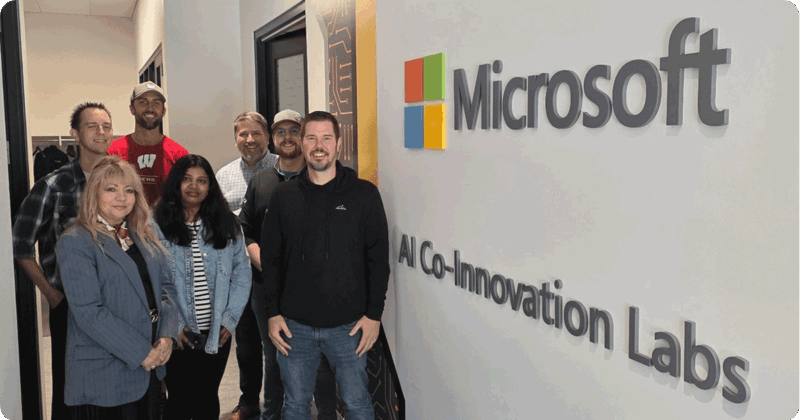
Julianna Javor, the lab’s manager (at front left), is shown with the team from Packer Fastener. The lab is helping Wisconsin companies develop AI competencies and solve challenges.
Wisconsin companies, guided by a cutting-edge new lab, are finding ways to tap the potential of artificial intelligence (AI) to boost productivity and profits while spreading knowledge of how AI tools can deliver workplace results.
Since summer 2025, the Microsoft AI Co-Innovation Lab at the University of Wisconsin-Milwaukee has helped companies—with an emphasis on the manufacturing sector—tackle problems with AI tools by working with small teams of employees to find custom solutions.
The lab, one of just three in the U.S., was founded through a partnership among Microsoft , WEDC, UWM , the Green Bay Packers , and Green Bay venture capital firm TitletownTech . Part of UWM’s Connected Systems Institute , the lab provides free four-day prototyping “sprints” in which teams from selected companies build working AI solutions to critical workplace problems.
The aim of the hands-on sessions, which include Microsoft’s AI engineers, is to help companies deploy the technology and work more confidently to develop AI-driven innovation. The Connected Systems Institute and TitletownTech help identify and prepare businesses likely to benefit from AI solutions.
“We ask: ‘What are the hardest, most interesting problem that you have in your process?’” says Matt Adamczyk, a Microsoft director based at TitletownTech. “Then, let’s work back and see how the technology can apply to these, because AI isn’t magic for everything. It can’t solve every problem. But when you find the problem it does apply to, it feels like magic.”
Sprinting toward solutions
The teams spend at least six hours a day working on solutions that they can take back to their workplace and put into operation.
“Our mission is to bring AI to Wisconsin,” says Julianna Javor, the lab’s manager. “Teams that come to the lab are often just five or six people. But after the sessions I ask them, ‘When you go back, how many people are you going to share this with?’ I have a running total, and right now it’s 1,060.”
Javor says that as knowledge of the technology spreads across an organization “people realize that their jobs aren’t going away because of AI, and that they are going to have more time to do high-value things.
“We’re not just creating a solution for a business to take and not know what to do with it. They create the solution, and have their hands on the keyboard,” Javor says. “If you’re doing it yourself, you learn lots more than if you’re watching someone else do it.”
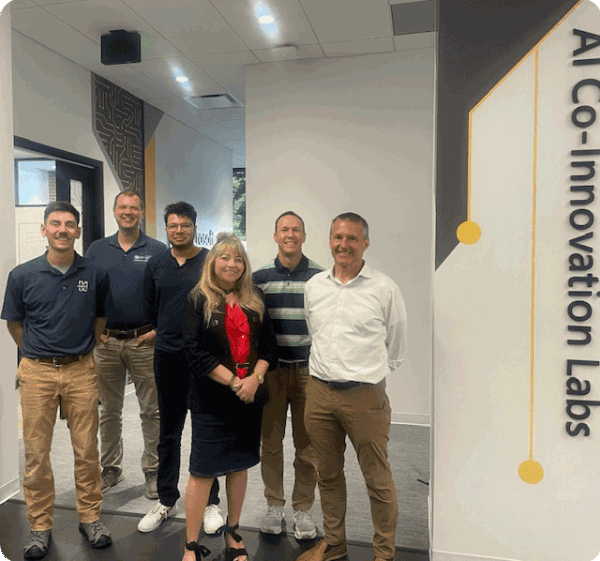
Husco’s team worked on AI solutions for interacting with suppliers around the world. Julianna Javor (front row center) manages the UWM-based lab.
The lab’s work is winning over skeptics and advocates alike.
Pat Masterson is one of the converts. He is vice president of global supplier quality at Waukesha-based Husco , a global company specializing in hydraulic and electro-mechanical components for the automotive and off-road highway markets. And he counted himself an AI skeptic.
“I was not a believer,” says Masterson, a mechanical engineer. “I just couldn’t find a good use case for Husco, and I wasn’t seeing true use cases where it was benefitting people’s businesses.”
He joined a gener8tor Generative AI Skills Accelerator and started to learn more about the technology and how leaders should think about it. In the class, he wrote a capstone paper about how AI could become a coach for Husco’s hundreds of far-flung suppliers, helping to ensure a smoother supply chain with fewer glitches and higher quality.
He pitched Husco’s idea to the lab and met a few times to refine the idea. “They walk you through a design-thinking process in a workshop setting and we break it down into project milestones,” Masterson says.
Masterson and three colleagues immersed themselves in a four-day session last August and emerged with a tool that was tested in the workplace and deployed to suppliers for their use. Supplier feedback, he says, was overwhelmingly positive.
“Our team’s job is to be a coach for that supplier and in the course of a week, we may have hundreds of contacts with them in phone calls and emails,” says Masterson. “Our suppliers around the world, especially the ones where English is a second language, find that the clarity of the words and the immediate feedback provided by the AI tool helps them resolve issues faster.”
The company estimates that one week in the lab will save 24 weeks of work in the workplace. And today Masterson teaches part of the same gener8tor class that began Husco’s AI journey and has developed a list of at least 10 more potential uses for AI technology.
From theory to practice
At Green Bay’s Packer Fastener, a threaded fastener and industrial supply firm, officials were enthusiastic about using AI tools to achieve a strategic edge and build on its constant drive for efficiency. But they struggled to find appropriate uses for the technology.
Then, Bill Feck, the company’s chief technology officer, met a representative of TitletownTech at a networking event in spring 2025 and learned about the lab. With Titletown Tech’s help, it refined ways to use AI on high-priority company processes.
The exercise eventually led a four-person Packer Fastener team to the lab in September. “It was one of the most impactful professional experiences of my career,” Feck says. “The amount you can learn in just a few days working directly with a Microsoft engineer is remarkable.”
There, Packer Fastener’s team worked to develop a tool that automated quote and order software, extracting key data from customer requests in PDFs, blueprints, and spreadsheets and match it with products SKU codes to streamline the quoting process. The tool, still in beta testing, is expected to yield faster customer response time and seamlessly scale for growth.
The new tool is expected to automate up to 75% of quote transactions, saving about 40 hours of work per month, Feck says. The project has spawned other ideas for using AI to improve efficiency.
“We’ve created a bit of a flywheel effect,” Feck says. “Now we’re identifying additional AI uses that we can deploy even faster. We feel like we’re just at the tip of the iceberg now that we know how to build AI into our business processes.”
Legal Disclaimer:
EIN Presswire provides this news content "as is" without warranty of any kind. We do not accept any responsibility or liability for the accuracy, content, images, videos, licenses, completeness, legality, or reliability of the information contained in this article. If you have any complaints or copyright issues related to this article, kindly contact the author above.
